Making local roads safer
John Symons
Editors’ note: In the aftermath of the incident that claimed Will’s life, advocacy organisation BikeWest sought updates from Road Safety Minister Melissa Horne as well as the City of Melbourne regarding the status of safer cycle infrastructure on Macaulay Road. Both gave written commitments to prioritising the works, with Melbourne’s Acting Director City Infrastructure advising they are hoping works will start in the coming months.
Here you can read the full version of a piece by BikeWest president John Symons, that was published in an edited form in the Summer 2025 edition of Flem Ken News.
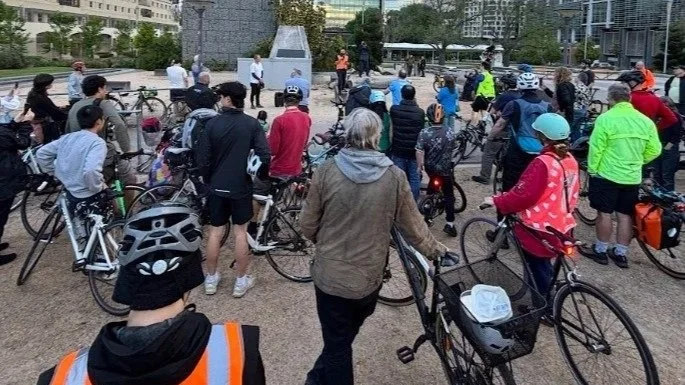
In September 2025, Will Richter was killed while riding his bike in Melbourne. He was struck by a truck driver at the intersection of Macaulay Road and Rankins Road.
In Australia, on average a person riding a bike is killed every nine days, nearly always in a collision with the driver of a motor vehicle. When considering the relatively small number of trips made by bicycle in Australia compared to motor vehicle trips, this represents a very high rate indeed, one of the worst in the world in high income countries.
There is an official investigation underway so we don’t know the full details of the collision, however, nearly all of these deaths follow a similar story. Tragically, the design of the intersection together with the downward slope made the risks of a collision, and the consequences of a collision, much greater than they should be.
Is this inherently dangerous intersection an isolated case? Sadly no – it is the norm for most of Melbourne and in particular, the western suburbs to be dangerous for cyclists.
The inner west of Melbourne has traditionally been an industrial area with many truck movements and the roads have been designed in such a way to prioritise the speed and flow of trucks and cars. This inevitably leads to roads being more dangerous for people on bikes or walking.
This approach to road design, with an emphasis on speed and quantity of motorised traffic, has been the accepted orthodoxy since the 1950s. It was only in the 1990s that a different way of thinking about road design was proposed. Unsurprisingly, this concept originated in Sweden[1].
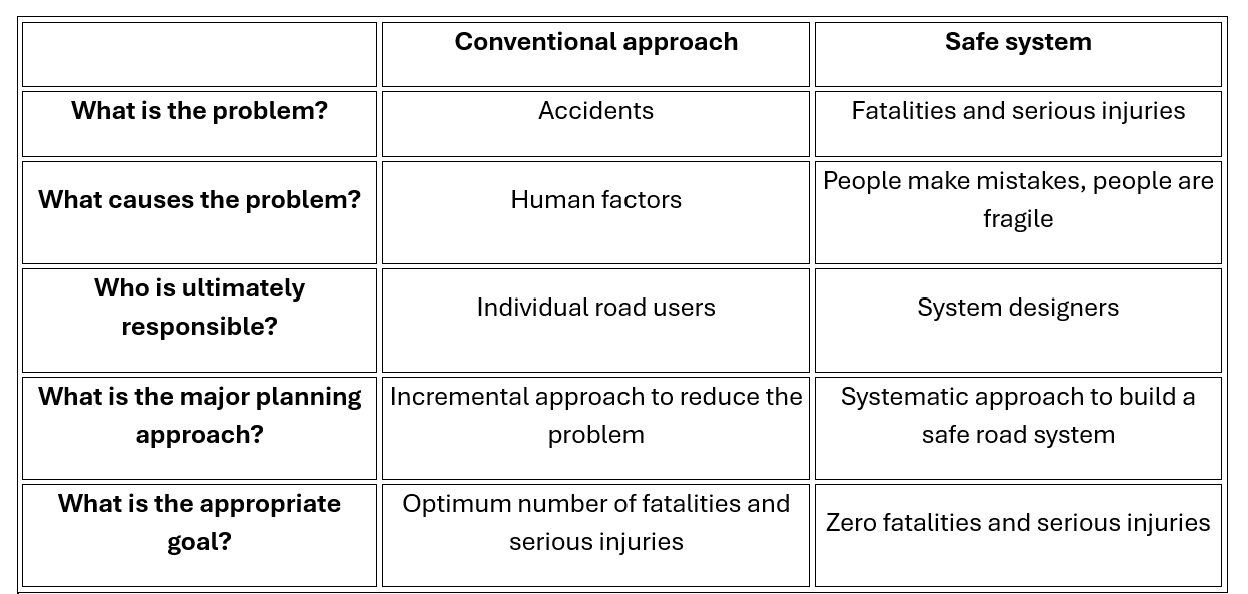
This approach has come to be known as the Safe System approach. As opposed to conventional approaches to road design of maximising the speed and convenience of motor vehicle drivers, the starting point for the Safe System approach is that everyone, regardless of what mode of transport they choose, arrives at their destination alive.
To achieve this outcome, there are 4 guiding principles:
Principle 1: Human Fallibility: People make mistakes which can lead to crashes.
Principle 2: Human vulnerability: The human body has a limited physical ability to tolerate crash forces.
Principle 3: Road safety is a shared responsibility amongst everyone, including those that design, build, operate and use the road system
Principle 4: Build a safe and forgiving system. All parts of the road system must be strengthened in combination and have layers of protection to multiply the protective effects and if one part fails, the others will still protect people.
The key differences between the traditional and Safe System approaches are summarised below:
Taking a Safe System approach means designing roads that ensure in the event of a collision, human tolerances to injury are not exceeded and forces are managed.
This necessitates separating vehicles of incompatible speeds and masses, for example by separating extremely heavy trucks from light and vulnerable road users, such as cyclists and pedestrians. The key speed above which different vehicles should be separated is 30kmh, as above that speed the risk of death increases exponentially.
Some people reading this will think this is pie in the sky stuff that will never work, but it has. In 2019 Oslo achieved zero road fatalities down from a peak of 41 after a comprehensive program of interventions following Safe System principles. The same has occurred in Helsinki.
In theory, road authorities have signed up to the Safe System approach in Victoria, but in practice, the Safe System continues to be ignored, especially for cyclists and pedestrians.
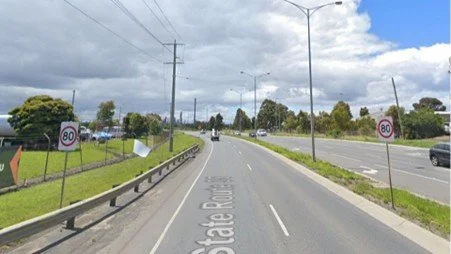
For example in the west of Melbourne there are no streets where the speed limit is 30kmh and it is common to find cyclists expected to travel on roads with trucks and cars travelling between 60 and 80kmh, protected by nothing more than a strip of white paint.
Kororoit Creek Road is a particularly notorious example. In the words of one Hobsons Bay City Council document, cyclists may find this “uncomfortable”. Terrifying and certain death if anyone makes a mistake are probably better words.
All too often, road authorities in Melbourne fall back on the dreaded sharrow (shared lane marking) which the latest research shows is more dangerous than nothing at all.
Given that most conflict points and collisions occur at intersections, the Safe System approach has led to a conceptual design called Protected Intersection which has been attempted in a half hearted manner on Albert St in East Melbourne. The protected intersection has four main features:
a Corner Refuge Island
a Forward Stop Bar for cyclists
a Setback bike and pedestrian crossing with small radius corners to slow drivers and improve field of view
Bicycle Friendly Signal phasing.
So, what would this mean for the intersection where Will was killed? As this intersection does not have traffic signals only some of these features are applicable. A significant improvement in safety would be to reduce the radius of the corner which automatically reduces cornering speeds giving people time to react and lessening the impact of any collision. When combined with a refuge island and bike lane setback, cyclists would be in the middle of the field of view, not in driver’s peripheral vision. This increases the likelihood drivers will see cyclists, have time to slow down and avoid a collision. This demonstrates how different parts of the system reinforce one another in the event one part fails. This approach has been adopted from the Swiss Cheese Model of Harm.
As has been shown all around the world countless times, when you make cycling safe for those who already cycle, an almost inevitable thing happens – more people start cycling.
More people cycling benefits everyone, even motorists, who benefit from reduced congestion as cycle lanes can accommodate five times as many people per square metre compared to car travel. The famously cycle friendly Netherlands is regularly voted among the best countries to drive.
A Footscray local and Monash University researcher, Lauren Pearson, published research recently that showed three in four people in Melbourne would ride regularly if it was safe to do so.
There are so many other benefits from more people cycling including:
improved public physical and mental health
stronger social capital
better air quality
reduced greenhouse gas emissions
reduced transport poverty
better productivity
improved local revenue.
This has been described as a ‘Miracle Pill’.
Will Richter was a well-loved young man with so much life ahead of him. The lives of the truck driver involved and their family have been altered forever as well.
It is possible to make cycling safe in Melbourne so incidents like this aren’t repeated. We just need to make it our priority and refuse to accept excuses.
[1] Larsson, Peter, and Claes Tingvall. "The safe system approach–A road safety strategy based on human factors Principles." In Engineering Psychology and Cognitive Ergonomics. Applications and Services: 10th International Conference, EPCE 2013, Held as Part of HCI International 2013, Las Vegas, NV, USA, July 21-26, 2013, Proceedings, Part II 10, pp. 19-28. Springer Berlin Heidelberg, 2013.